
Where Traces Remain — The Creative Process
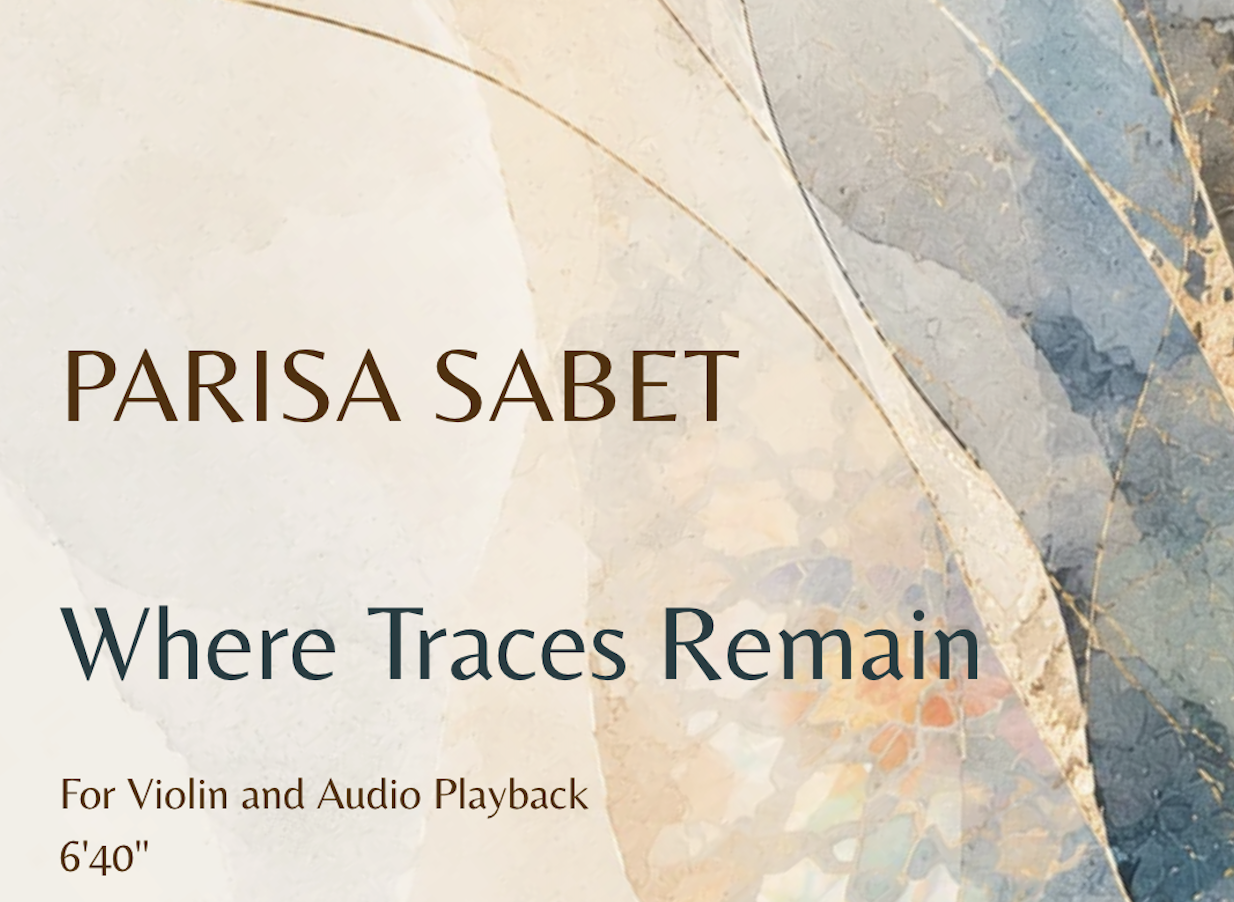
When I began composing Where Traces Remain, one of the things that excited me most was the opportunity to write for violinist Roan Ma. We had wanted to collaborate for some time, and I hoped to create something that would challenge her technically while also being enjoyable to perform. Throughout the compositional process, Roan and I worked through sketches together, and I received her feedback as the piece developed. Early in our conversations, she mentioned that she was interested in extended techniques but also wanted the piece to show the beauty of the violin. I remember how much she liked one of the melodic sections I shared with her. When I mentioned that I was also thinking of writing something more rhythmic, she became even more excited. I enjoyed these conversations and hearing her reactions as the piece took shape.
My original idea was to begin with a dense, almost chaotic texture, with many sounds layered together. I imagined gradually pulling these sounds apart, allowing us to hear and appreciate them individually, until only one beautiful melodic line remained.
But as I started composing and working with the audio playback, the piece began to take a different shape.
The audio playback is built from recordings of two instruments: the violin, recorded by Roan, and the tar, an Iranian plucked string instrument, recorded by Arman Nikaeen in Iran.
In late spring 2026, as internet access began to return to Iran after months of disconnection, Arman reached out and asked whether we could collaborate. I asked him to record a collection of sounds and extended techniques on the tar for another project.
Receiving those recordings meant a great deal to me, especially after a period when I had felt particularly disconnected from Iran. As I spent more time listening to and working with them, that sense of connection grew.
While composing Where Traces Remain, I began hearing similarities between the sound worlds of the tar and violin. I started experimenting with the recordings in Cubase, layering, processing, and combining their sounds. I became interested in how the two instruments could meet and transform one another. What had originally been recorded for another project gradually became an important part of this composition.
As I developed the audio playback and the live violin part, the musical form began to change.
The opening ended up being quite sparse, very different from the dense texture I had originally imagined. I became interested in the continuous transformation of timbre, moving between clear pitches, fragmented gestures, scratch tones, sul ponticello, and sul tasto. I wanted these sounds to flow naturally into one another, without clear boundaries between them.
As the piece progresses, plucked sounds gradually become more prominent in the audio playback. This leads to an improvisatory section where Roan can use either pizzicato or a guitar pick. There are a few musical gestures as starting points for improvisation, drawn from material that appears later in the piece.
Interestingly, this middle section became the densest part of the composition. From there, the music moves into more melodic and rhythmic passages, while the plucked gestures gradually return more sparingly.
One of the most time-consuming parts of composing this piece has been coordinating the live violin with the audio playback. I wanted Roan to have some freedom in how she performs certain sections while still being able to follow the fixed timing of the recording.
This meant creating recognizable musical cues in the audio playback and marking the corresponding moments in the score, both to signal important entrances and transitions and to help her stay aligned throughout the piece. I spent a lot of time moving back and forth between Cubase and Sibelius, adjusting the playback, checking the timing, and updating the notation. Even a small change in one could require adjustments in the other.
Listening to the finished piece, I hear something of a palindrome-like form. The opening and ending feel like two sides of the same coin. The sounds are different, but they seem to emerge from the same musical world. The ending also changes how I hear the beginning. Neither feels more complete or more beautiful than the other; they are different ways of experiencing related sounds and gestures.
I didn't plan this form. It emerged as I worked with the recordings, experimented with violin techniques, and moved back and forth between the score and audio playback.
Looking back, I can still recognize my original idea in the piece, even though it developed in ways I hadn't anticipated.
Where Traces Remain (6′40″), for solo violin and audio playback, was commissioned by Music Toronto for violinist Roan Ma. The work will premiere on November 24, 2026, at the Jane Mallett Theatre in Toronto.
- Log in to post comments