
Compositions

A Girl Who Missed the Train
Image

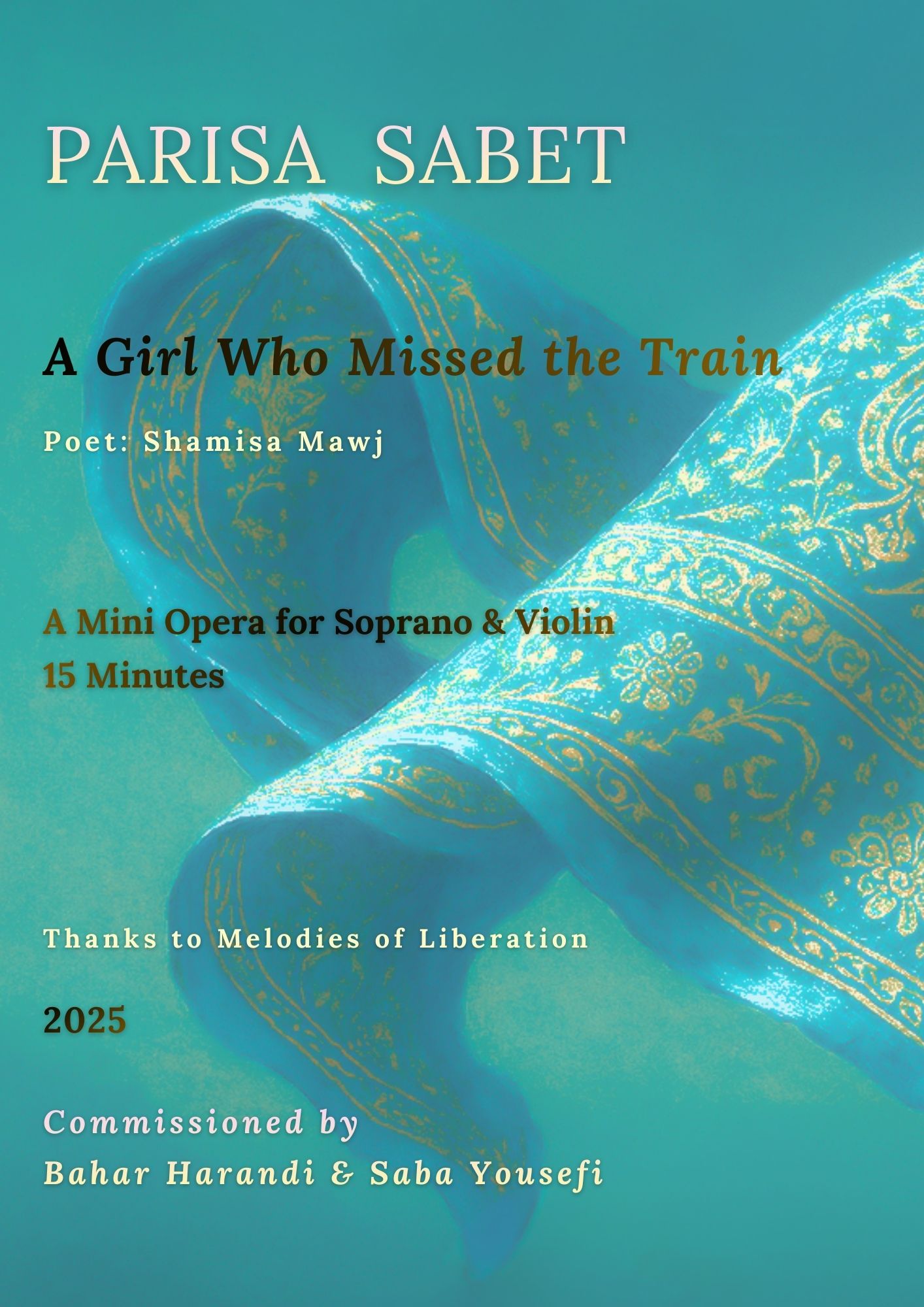
A Girl Who Missed the Train is a mini opera for soprano and violin, based on a poem by Shamisa Mawj. Through the voice of this poem, a classically trained opera singer is invited to inhabit the reality of an Afghan girl, tracing her inner landscape through music.

The work seeks to create a space of transformation—for performer and audience alike—where emotional and cultural distances may begin to narrow. While no one can fully experience another’s pain, music can draw us closer to lives beyond our own. In that closeness lies the possibility of deeper empathy—and from empathy, meaningful action.

Commissioned by Paisley Due.
With special thanks to Melodies of Liberation.

A girl who missed the train, 

Now she is like a boat, under the rain of loneliness, 

left unmanned amid storms 

A girl whose lashes are dusty from the house chores, 

and her moon-like face has been darkened by the oven's smoke 

A girl who craves education, But dirty hand of politics has sealed the school against her,

And acid has been burned her papers and her dreams 

A girl wanders the streets, searching for a piece of bread. 

She shines men's shoes, because she is the only man in the family 

A girl whose hair is feared by all, So, they concealed her hair. 

A girl who everyone is afraid of her revolutionary eyes 

And they cover her eyes. 

Who called this graveyard a country?

This is a graveyard where one by one, the young are buried with their dreams life suffers within me,

it is years a girl has been dead inside me, 

A girl who carries her own dead body on her shoulders, 

while all watches in silence.


Sabzeh 2024-2025

Image

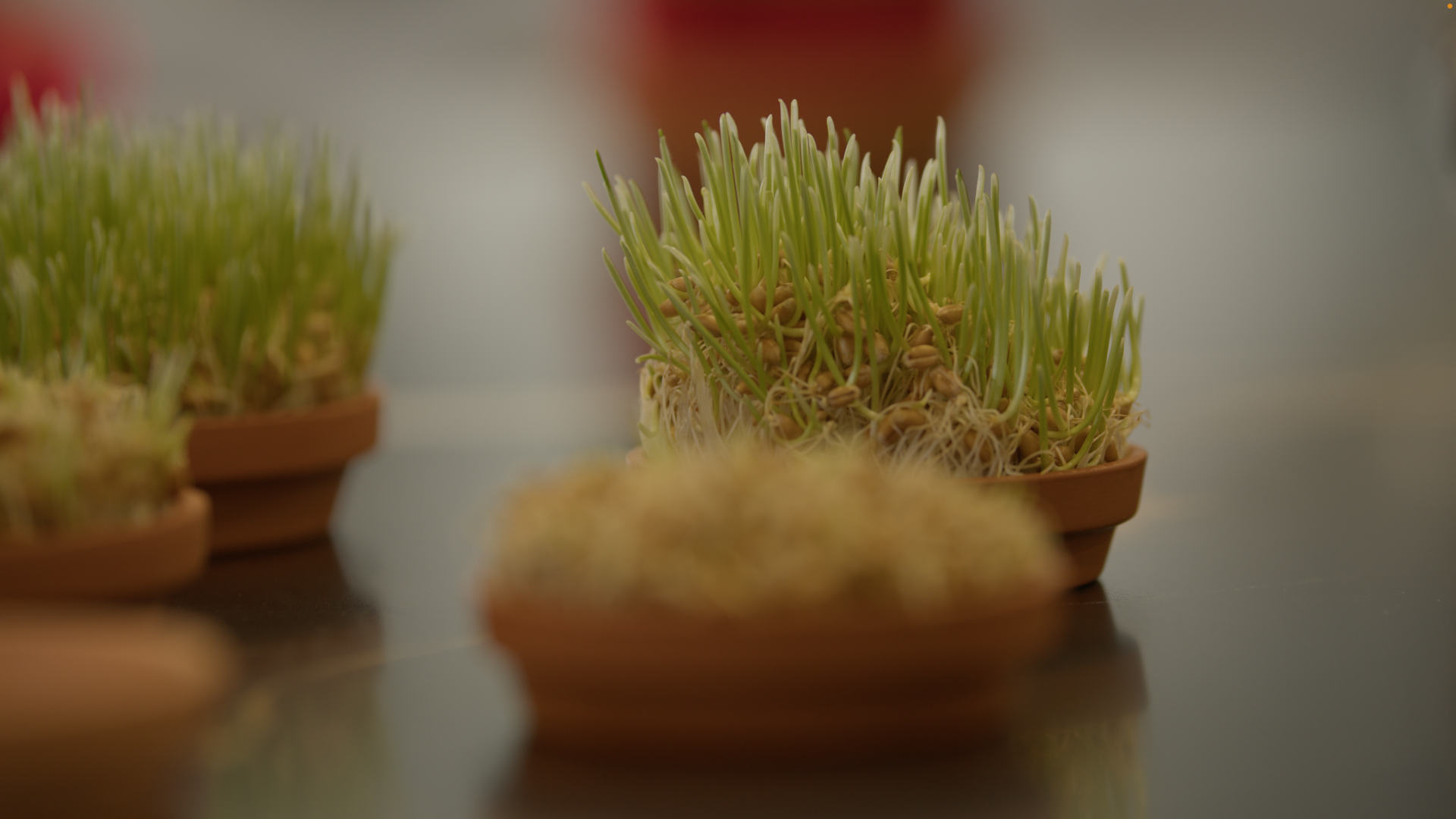
Inspired by Omid Fallahazad’s story Sabzeh, this immersive installation brings together music, dance, fiber arts, and visuals rooted in Persian carpets and growing sprouts. Like knots woven by hand or seeds pushing through the dark, beauty and strength appear when we hold each other through all seasons of growth. Some of us are just beginning to sprout, others stretch further toward the light — yet all are vital. Even when lives are unjustly cut short, their spirit and impact endure, reminding us that we are bound together. The work honors the ten Baha’i women executed in Shiraz, Iran, forty years ago, and invites us to see our deep interconnectedness — to remember that through unity, we hold the power to rise, resist injustice, and nurture change.

Aurora Cultural Centre Homeroom Galleries, Aurora Ontario August 14 to October 19, 2025


Where Thou Smile, There is Home (2024) 4'00"

Where Thou Smile, There is Home is a duo composed for violin and viola. It was commissioned by violist Muriel Razavi and violinist Ava Bahari.

Stay tuned for premiere information at the Houbara Festival in Cologne in April 2024.

Sepideh (2023) 8'00"

Sepideh is a multimedia composition for solo piano, video, and audio playback. The title itself carries a dual meaning, symbolizing both the dawn and an Iranian woman's name.


The creative process behind this work holds a special place in my heart. For me, it brought together two communities I belong to—mothers and children, and artists—that had never come together in a creative project before. I was grateful to collaborate remotely with Spanish vocalist Sandra Sangiao and Toronto-based pianist Yun Lee Young, and to work with Joshua Weinfeld of Continuous Motion Production, who recorded and edited the visuals.

The colorful ribbons woven through the piece carry deep symbolic meaning: in many cultures, they appear in women’s traditional costumes as expressions of resilience, identity, and the enduring strength of women across generations.

My hope is that this composition invites the audience to reflect on our shared resilience and the quiet power of human connection.


How Could I Know (2023) 5'00"

How Could I Know is a duo for clarinet and piano commissioned by Toronto-based clarinetist, Peter Stoll. It is inspired by Rumi's Ghazal, Swallowing the Sun.


How Could I Know reflects how the Women, Life, Freedom movement pushed me out of my comfort zone, forcing me to confront the disorder within myself and around me—disorder I had been avoiding for a long time. At the heart of the piece is a process of striving for change and learning to accept the present while embarking on a journey of transformation.

HOW COULD I know this melancholy
Would make me so crazy,
make of my heart a hell
of my two eye raging rivers?
How could I know a torrent would
snatch me out of nowhere away,
Toss me like a ship upon a sea of blood,
that waves would crack the ship’s ribs board by board,
tear with endless pitch and yaw each plank
that a leviathan would rear its head,
gulp down the ocean’s water,
  that such an endless ocean could dry up like a desert,
that the sea-quenching serpent could then split that desert
could jerk me of a sudden, like a Korah, with the blend of wrath
deep into a pit?  

When these transmutations came about
no trace remained of that desert or the sea
How should I know how it all happened
since how drowned within Howlessness?

What a multiplicity of how could I knows?
But I don’t know-
for to counter that sea
rushing in my mouth
I swallowed a froth of opium

Ghaal 1855
Translated by late Dr. Franklin D. Lewis


Goodnight Moon (2023) 8'00"

Goodnight Moon is a composition for voice, cello, piano and audio playback commissioned by a Montreal based trio, Noise Partout. Stay tuned for premier information!

Minakari (2022) 6'00"

Minakari (2022) is a solo piano composition commissioned by pianist Melody S Quah

I find Minakari an elegant, delicate, and sophisticated form of art and I am mesmerized by the beauty that these detailed oriented colorful geometric patterns create.

The first time I talked to Melody, she had a similar impression on me: a pianist with an elegant, delicate, and sophisticated personality. Her piano performance was not different. Therefore, I decided to use characteristics of Minakari as my source of inspiration for this composition.

Minakari is the art of miniature painting and coloring on ceramics and metal. The word Minakari has two parts: Mina and Kari. “Mina” is associated with the word Minoo (a feminine name) meaning heaven. It is also defined as the blue sky in Farsi. The design usually has bright colors primarily blue and detailed geometric patterns with small variations.  
 

His Gabbah Is Turquoise (2022) 9'00"

His Gabbah Is Turquoise (2022), is a composition for double bass and piano comissioned by Ali Kian Yazdanfar for Sayeh Roshan Project.

His Gabbah Is Turquoise (2022) is a commission by Ali Kian Yazdanfar for the Sayeh Roshan Project. Its musical elements are inspired by patterns, textures and colors found in Gabbah. Gabbah in Farsi means raw, natural, and uncut and is a type of Persian rug with bright colors and rough and primitive textures. Its patterns are formed by asymmetric and symmetric knots and can be as diverse as the mind and imagination of its craftsman. The color turquoise represents wisdom, tranquility, protection, good fortune, and hope.

When I asked Ali what elements of Iranian music or culture most interested him, he referred to his memories with his father talking about different aspects of Persain culture. I have been wanting to compose a piece dedicated to my father as well. His Gabbah Is Turquoise is a homage to the fathers.

We acknowledge the support of the Canada Council for the Arts. Nous remercions le Conseil des arts du Canada de son soutien.


Silent (2022) 8'00"

Silent is a multi-media composition for clarinet, cello, piano, soprano, tenor, audio playback, dance, and visuals commissioned by Charsu Quartet. It is inspired by The Wind-up Doll, a poem by an influential Iranian poet, Forough Farokhzad (1934-1967). Influenced by the poem’s perspective on the ways a male-dominated social system in Iran has destroyed women’s lives, I aimed to depict the feelings of an emotionally, physically oppressed woman struggling towards change.

We acknowledge the support of the Canada Council for the Arts.

Stay tuned for premier information!

(Binaural Version) USE YOUR HEADPHONE

The Sounds of Cities Album, Yu Tsz Long


Then It Was This One (2021) 5'00"

Then It Was This One is composed for clarinet, piano, and cello. It is inspired by Uzeyir Hajibeyli's operetta, If Not That One, Then This One. The composition received Certificate of Achievement & Publishing in the USA from the Hajibeyli International Composition Competition.